HOW TO BUILD QUALITY AFFORDABLE HOMES AT SCALE—LESSONS FROM SWEDEN
The Miljonprogrammet ‘Million Homes Programme’ in Sweden (1965-1974) is an inspiring example of policy-makers reaching agreement to confront multiple housing issues head-on is. It is informative to explore how the idea emerged and the building goal, equivalent to ~⅓ of existing housing stock, was exceeded in a country with a population less than ~8 million at the time. Preconditions for achieving the goal included state loans, innovative construction systems and the provision of land by local municipalities. The goal was reached in less than 10 years.
The ambitious goal and the societal dynamics that coalesced to enable its realisation is nicely described in a research paper titled “The Million Homes Programme: a review of the great Swedish planning project’ by researchers Thomas Hall and Sonja Vidén (2005) where they discuss the housing and political settings that ultimately manifested in the the Miljonprogrammet, the challenges involved, how it was achieved, and how history has viewed it. Sweden was fortunate to avoid involvement in World War 2 and the contingent widespread damage to housing stock and the Miljonprogrammet was conceived to address other issues associated with rapid urbanisation including housing shortages, decade-long waiting lists to obtain a state rent-regulated home and comparatively low housing standards. In the early 1960s these factors, combined with rising prosperity and increasing demand for better quality homes, had already kick-started a surge in building and in 1965 the Riksdag (Swedish Parliament) leveraged this momentum with an ambitious goal to build 100,000 homes every year over the next 10 years to resolve the issues. The period 1961-1975 later became known as the ‘the record years’.
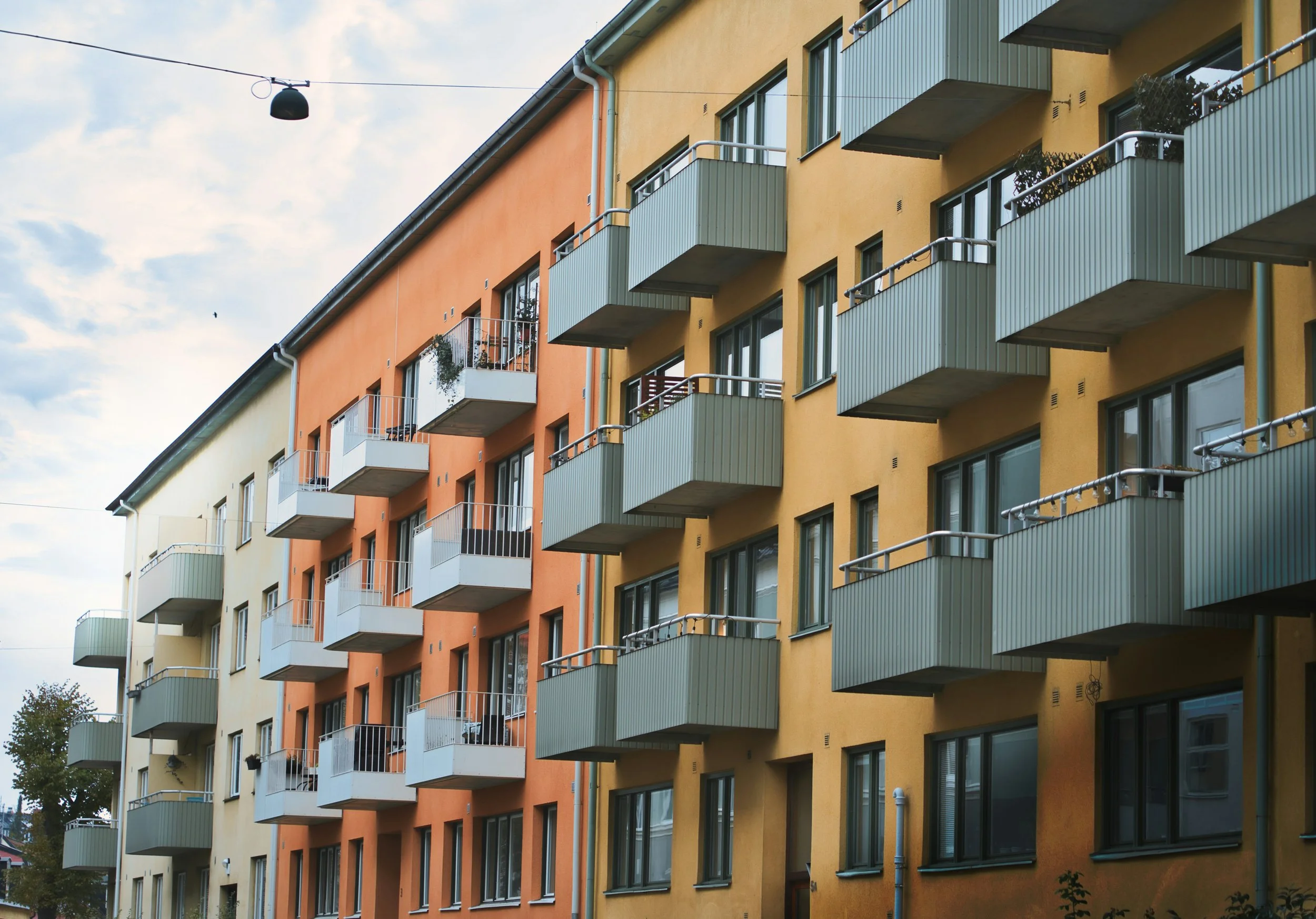
Preconditions for achieving the goal included low cost state loans, industrial-scale construction systems and provision of land by municipalities. The goal was reached before the end of 1974. During ‘the record years’ ~40,000 apartment blocks containing ~920,000 apartments (66%) and ~480,000 single-family houses (34%) were built. Standardised design, scale and prefabrication (exterior and internal components) were prioritised by the state for financial and other support and regarded as necessary to produce affordable housing of an appropriate standard. As such projects comprising 1,000+ apartments that could be replicated were offered preferential loan terms. Of the apartment housing, ~50% was built by municipal housing entities, ~30% by tenant-owned cooperative building societies and ~20% housing by private rental housing corporations. The early ‘Modern Movement’ influenced the architectural style of concrete tower blocks typically site-cast (only ~15%-20% pre-cast) of which ~50% were three-storey slab blocks, ~20% lower slab blocks and row houses and others between six and eight storeys high. The majority of the single-family homes were built by private developers in identical groups, often ‘catalogue’ designs, using prefabricated components with timber being the most common material for both framing and exterior cladding.
Thomas Hall and Sonja Vidén note that during ‘the record years’ housing standards were vastly improved with household overcrowding (affecting ~34% of households in 1960) and lack of ablution facilities (affecting ~45%) reduced to ~5% of housing stock by 1975. The homogeneity of design has attracted criticism and also accolades but what cannot be faulted is the realisation of an ambitious building goal and access for a very large cohort of households to something that was previously unattainable — affordable and good quality housing. Thomas Hall and Sonja Vidén speculate that in comparison to rented apartment estates in “Berlin, Madrid, Rome, Paris, Riga, Budapest, Bratislava and the UK” built during the 1960s and 1970s “the technical quality of construction is higher, the flats are better planned and equipped, greater interest is devoted to the external environment and public and private services are better developed”.
Leading up to (and following) the Miljonprogrammet state intervention in the housing market was not a new phenomena for Sweden and this is succinctly recorded in the Terner Centre report ‘Housing in Sweden: An Overview’ (2017). The Swedish Riksdag approved state support for housing construction in 1917 in response to poor housing conditions and a lack of building activity but this was curtailed in 1922 and deferred to the market. It wasn’t long before the Riksdag felt the need to intervene again during a farming downturn and unemployment crisis in the early 1930s where it introduced loans and subsidies aimed at improving rural housing conditions. By the end of World War 2 a stalled housing construction sector had resulted in the overcrowding and poor quality of housing that pressured the Riksdag to intervene again — introducing low cost state loans to boost construction and rent controls to protect existing occupiers. State loans of up to 100% of initial outlays ushered in the establishment of Municipal Housing Corporations (MHCs). Sweden’s Social Democrats who held office from 1932 to 1976 promoted “universal” housing as a “non-subservient” priority and did not differentiate based on socio-economic classification. State support was implemented via municipalities and enabled through both funding and fiscal measures. What followed was another housing sector hiatus which presaged the Miljonprogrammet.
In 1991 a neo-liberal centre-right coalition embarked on a two-pronged approach of housing sector privatisation and prioritisation of private ownership — transferring risk from the state to both municipalities and individual house owners. The preferential treatment of MHCs was diminished and means testing was introduced — signalling a shift toward private sector delivery of housing and a shrinking state role. State loans and fiscal incentives for municipalities were removed and interest rate subsidies and guarantees diluted. Robert Emanuelsson in his 2015 report ‘Supply of Housing in Sweden’ for Sveriges Riksbank (Sweden’s central bank) attributes these reforms, and challenging economic conditions during the banking crisis in the early 1990s, to one of the largest ever declines in Swedish construction activity.
As a result of the centre-right coalition government reforms, municipal housing corporation borrowing terms reverted to market with obvious cost implications. The suite of neo-liberal reforms and political preference for private ownership, which included legalising conversion of public social rental housing to cooperative housing, had a negative and long-lasting impact on the construction of rented accommodation. Data from the Swedish National Board of Housing, Building and Planning shows only marginal increases in the total number of rental properties for the period 1990-2011 while at the same time the number of tenant-owned properties increased by more than ~300,000 (~180,000 of which were converted from rental homes). The surge of such conversions was especially evident in the Stockholm region, where for every residential rental property built in the period 1991-2010, an estimated three were lost to ownership conversions.
A positive outcome from the ebb and flow of Swedish housing policy in housing mix was the emergence of a quite large (equity) cooperative housing sector. Today not-for-profit housing (in all its forms) comprises ~42% of all housing stock in Sweden and ~67% in Stockholm. Cooperative housing stock (rental and ownership) comprises ~24% of total housing stock in Sweden and ~50% in Stockholm. This large proportion of social housing in the overall market was no doubt assisted by the rapid expansion in public housing stock during the Miljonprogrammet supported by direct state intervention implemented at the municipal level. The neo-liberal reforms that dismantled low-cost state loans and other fiscal incentives and introduction of condominiums as a legal tenure facilitated the transfer of public rental housing to the private owner market and generated financial windfalls for those purchasers — echoing Margaret Thatcher’s reform of the municipal housing sector in the United Kingdom through a similar ‘right-to-buy’ scheme. Fallout from the neo-liberal policy wrecking-ball has a long tail and Sweden (like many western countries) is again hobbled by housing sector issues — supply, price escalation and volatility — especially in large urban areas (i.e. Stockholm) and unregulated parts of the housing market.
Distinct differences emerge from Sweden’s housing policy compared to that in New Zealand. There is a long social tradition that good quality and affordable housing should be available ‘universally’. Political consensus and state intervention — low-cost loans, guarantees, tax incentives, municipal involvement, regulation — have provided the impetus when needed. Sweden’s municipal housing corporations operate autonomously as not-for-profit entities and compete in the open market and cooperative housing comprises a large share of total housing stock. Market risk is diversified, with a mix of public, cooperative and private actors (social rental, not-for-profit and private ownerships).
Whilst on this topic, it is appropriate to also touch the very high cost of building which has become a vexing and unresolved issue in many developed housing markets. The root cause remains illusive and is likely multi-dimensional, involving a combination of market oligopoly (both constructors and materials supply chain), skilled labour and training constraints, lack of innovation and limited actors in manufacturing systems, downright ‘greedflation’, and political laissez-faire. Political vision, innovation in building pre-fabrication systems and the scaling-up of resources that accompanied the Miljonprogrammet is absent. Of course innovation in building systems and materials development, or supply chain disruption from new entrants or adoption of international product certification systems, will count for little if any cost savings arising from such measures are simply captured by key sector actors as profit. In the absence of third sector actors applying a ‘lowest-cost’ housing model this will happen.
© Níall Mayson